The limits of LLMs
PhotoCraft, REA and a new game port every week convinced a lot of people that Adobe is dead and programmers are next. I read the code and the numbers. Seven short points on what AI copies well and what it can't.
LLMs can replicate what's open, but they can't guess what's private.
LLM consegue replicar o que é aberto, mas não adivinha o que é privado.
Copying what's already public
Models learned from public code. When something similar was published, an agent rebuilds it fast and cheap.
- 81.5%
- of GitHub contributions happen in private repositories (Octoverse 2025)
- 67.5 TB
- of public code in The Stack v2, the kind of data models train on
- That's why one person can now ship a native Spotify or WhatsApp client in Rust. The service, the libraries and the path already existed. Retracing a known path got cheap.
- The code that pays salaries is mostly private. No model has seen it, and no model can guess it.
- Where nothing similar exists, the agent falls back on trial and error. What helps is what the model lacks: references nobody published, an oracle that says what's right, and tests with objective targets.
Taking binaries apart is 40 years old
Every emulator you ever used exists because someone took a binary apart. AI joined an assembly line that was already running.
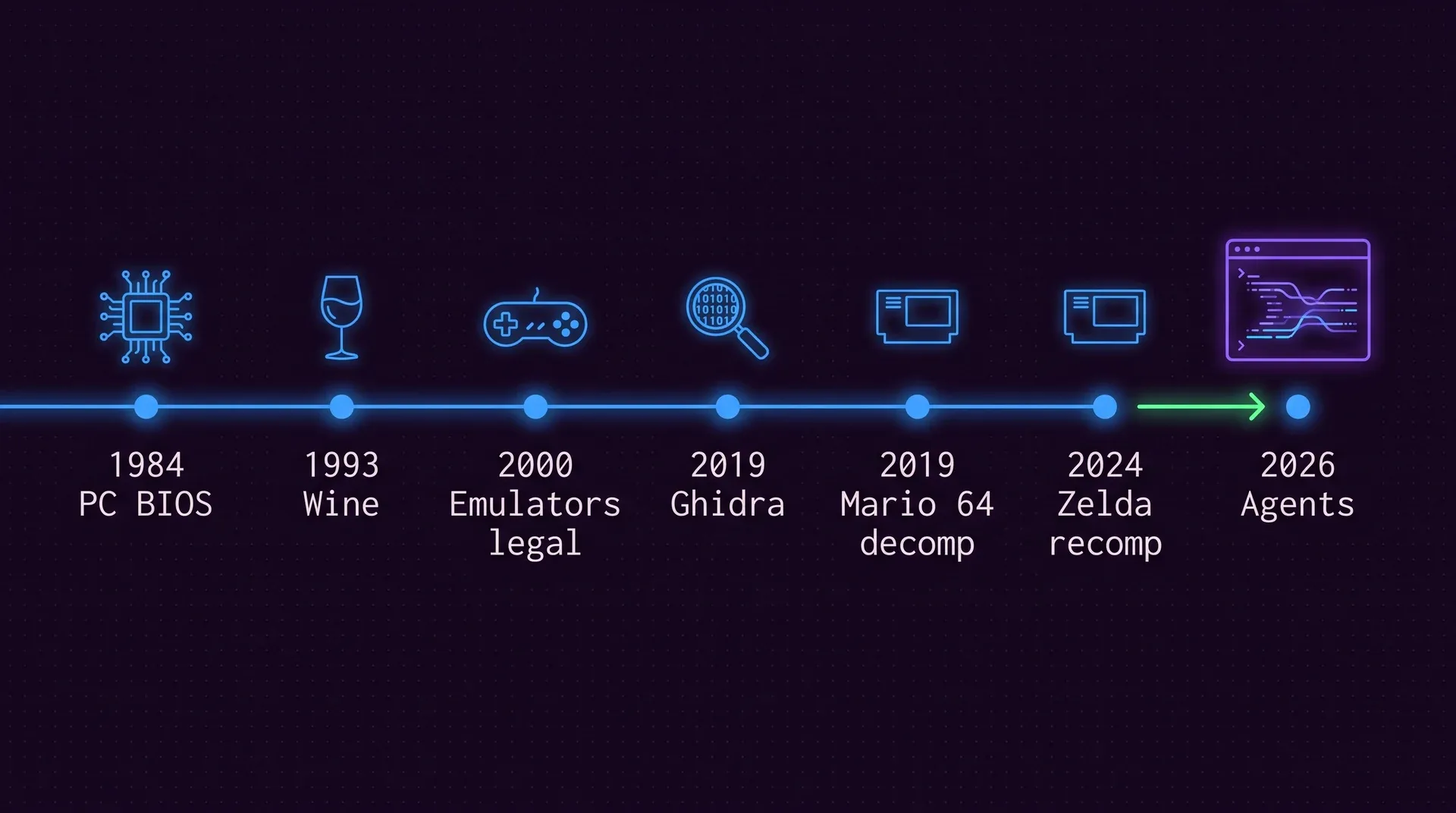
- US courts settled the basics in 1992 (Sega v. Accolade) and 2000 (Sony v. Connectix): disassembling code to learn how it works is fair use.
- The tools are mature, and many are free. The NSA released Ghidra in 2019, the same year the Super Mario 64 decompilation went public.
- LLM decompilers write more readable code than commercial ones, with 52% lower functional correctness (DecompileBench, 2025). The assistants in real use name variables on top of what Ghidra or IDA produced.
- REA, close to 200,000 stars on GitHub, hands those same tools to your agent. You need the binary, the tools installed and a lot of tokens: its own SQLite test took 42 tool calls and 300,000 input tokens. Its docs tell you never to say it clones a program.
Why old games fall first
A new retro port ships almost every day. Old games have every advantage a live product lacks.
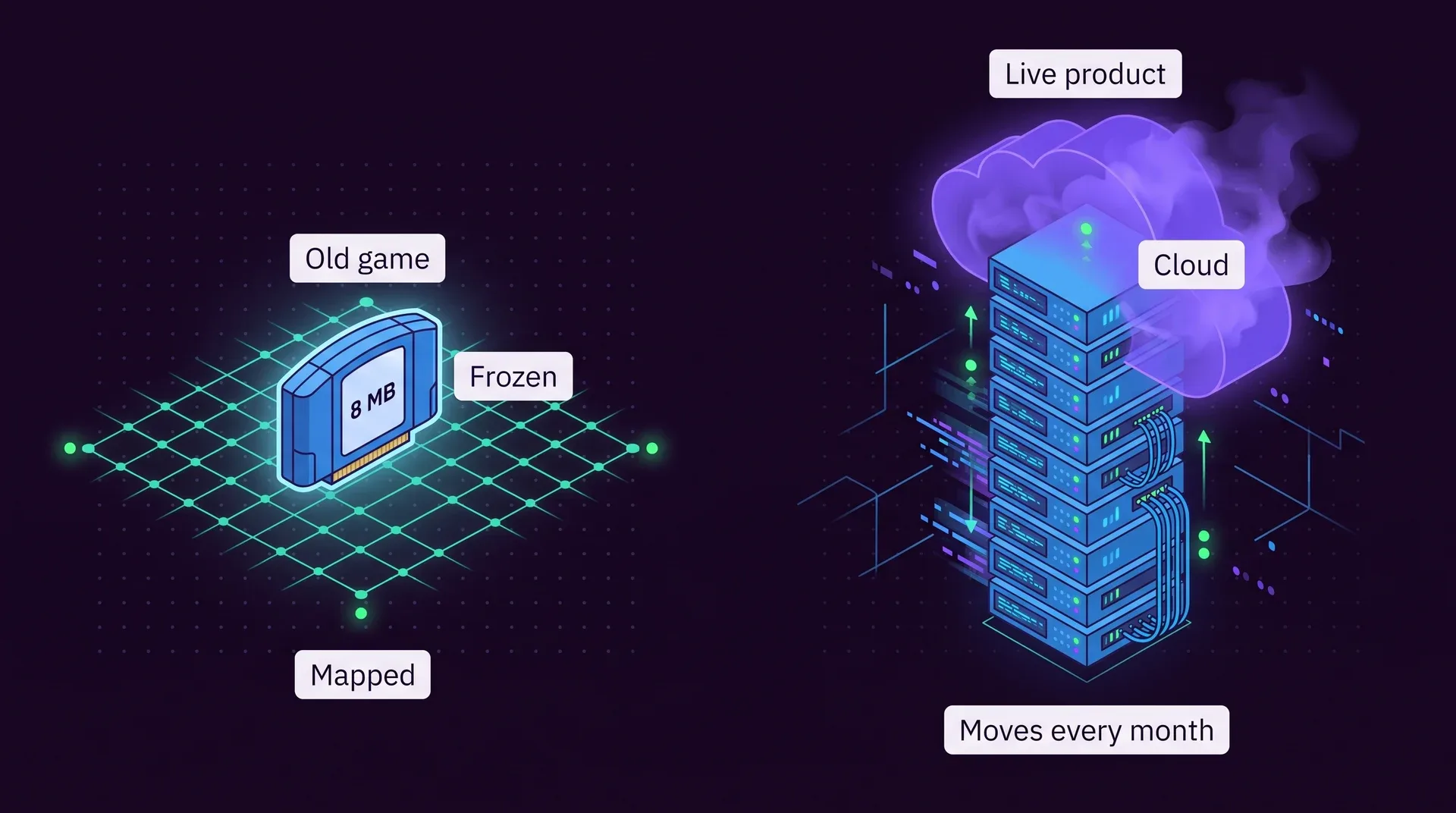
- The binary is tiny. Super Mario 64 is 8 MB. Baldur's Gate 3 is 150 GB.
- The hardware has been mapped instruction by instruction for 25 years, and the target never changes. Nobody is updating 1998's Zelda.
- PS4, PS5, Xbox and Switch are PCs or phones in a different case. Your processor already runs their code, and Wine, DXVK and Proton solved most of the graphics translation years ago.
- AI sped up the grunt work. The developers of the Zelda and Banjo recomps call the agent-made ports "slopcomps": untested, and patched in a way that makes them hard to maintain.
A screenshot of Photoshop
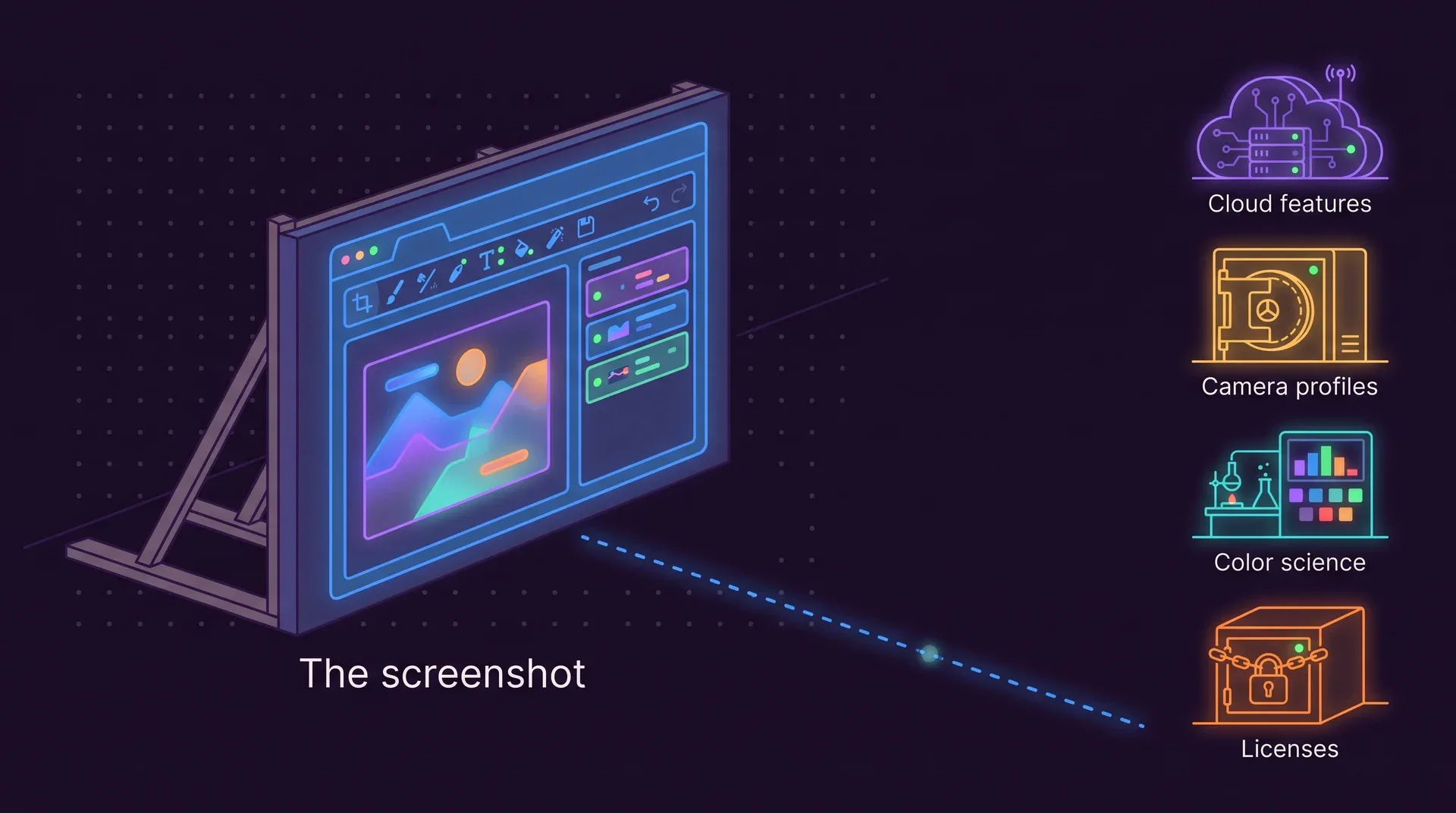
PhotoCraft looks like Photoshop in a screenshot. What people pay Adobe for lives somewhere else.
- 968
- open issues on PhotoCraft, read October 13, 2026
- 13
- days after the repository was created
- PhotoCraft was written in Rust with Claude. Its own README says early alpha. Images above 8,192 pixels fall back to the CPU, color management is basic, and about 100 open issues are about PSD files.
- Generative Fill and several Neural Filters run on Adobe's servers. That code never reaches your machine, so there's nothing to take apart.
- Camera Raw carries 20 years of profiles for each camera and lens. A clone either has that data or it doesn't.
- Print color is a field of its own. GIMP was born in 1995 and still has no CMYK editing in version 3.0. Pantone colors are licensed, and even Adobe lost them in 2022.
- Most software today runs as a service. The code behind Google Docs never leaves Google's servers, so there's no binary at all.
PhotoCraft today is that Ferrari replica built on top of a VW Beetle: the body has the right shape, you take a photo and most people say "wow, a Ferrari". Then you turn the key and out comes the Beetle engine.
O PhotoCraft hoje é aquela réplica de Ferrari montada em cima de um Fusca: a carroceria tem a forma certa, você tira uma foto e a maioria das pessoas diz "uau, uma Ferrari". Aí você liga e sai o motor de Fusca.
What a big rewrite costs
The best public number comes from Bun, the JavaScript runtime, rewritten from Zig to Rust with agents in May 2026.
- $165K
- at API prices
- 11
- days, 535,000 lines of Zig
- 64
- Claude agents at the peak
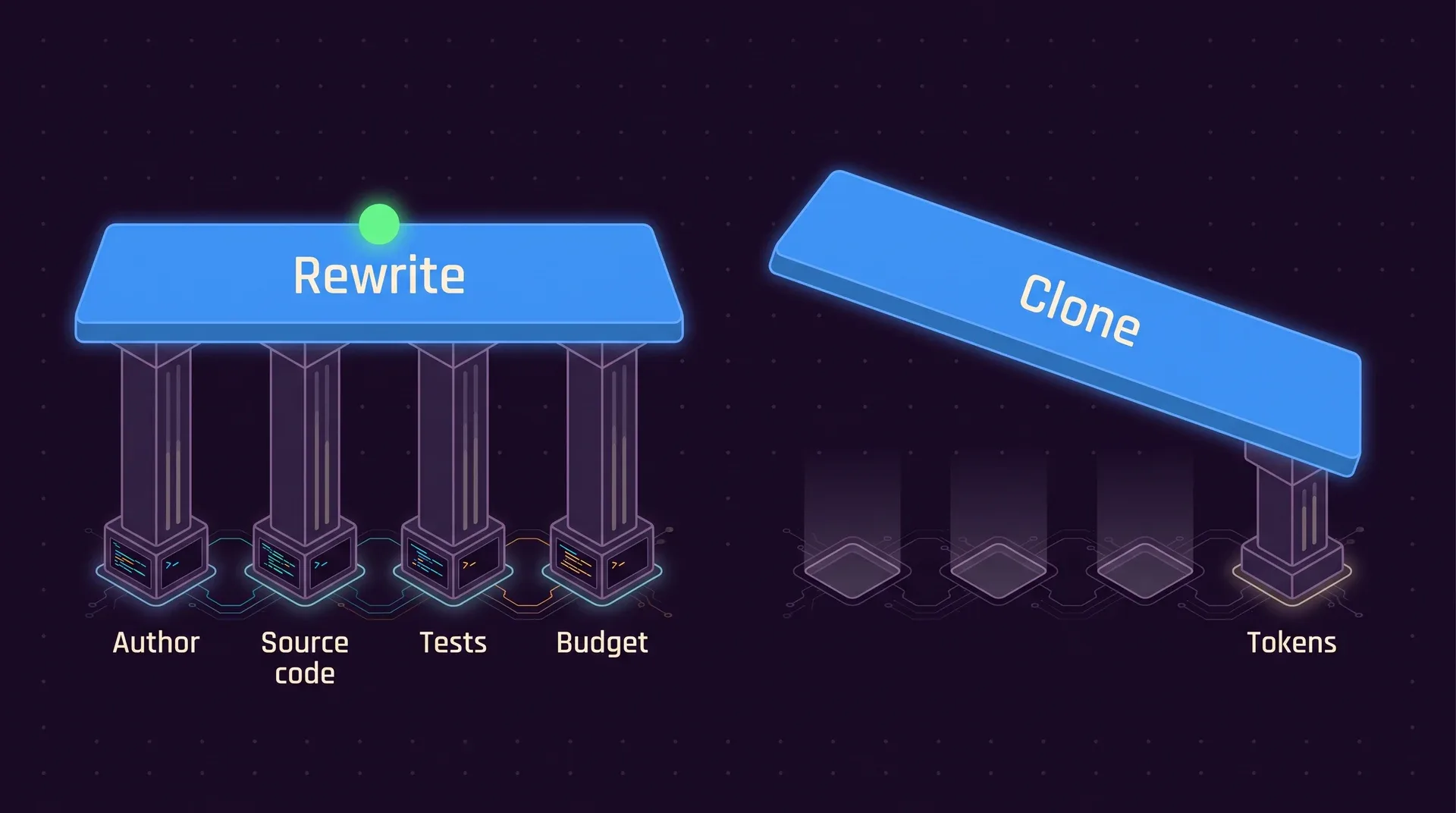
- It worked because of four things: Bun's own author at the controls, the full working source, about 60,000 tests per platform to check every change against, and Anthropic, which owns Bun, paying.
- Anthropic's C compiler, February 2026: 16 agents, under $20,000, and it builds Linux. It still borrows GCC's assembler and linker, and its code runs slower than GCC with every optimization turned off.
- A Photoshop clone has none of the four. There's no source to port, no test suite that says "matches Photoshop", and no author. And Photoshop is a 36-year-old product, far bigger than a runtime.
"In two years it will be free"
The price of the best models barely moved since 2023. What fell fast is the price of a quality level that's already old.
- $60
- per million output tokens, GPT-4, March 2023
- $50
- per million output tokens, the best models, October 2026
- The frontier got 1.2 to 3 times cheaper in three and a half years, depending on input or output tokens.
- A fixed level of quality gets roughly 5 to 10 times cheaper every year, by Epoch AI's estimate, and they expect that to slow down.
- Do the math on Bun: $165,000 divided by 100 is $1,650, for a port with the source, the tests and the author in hand. Cheap and trivial are different things.
- The models themselves converged, and the recent gains came from the agent tools around them. I explain that on the AGI page.
Are programmers dead?
Every rewrite and every decomp that works has an engineer at the controls.
- +15%
- US software job postings since Claude Code launched in February 2025, while all postings fell 7% (Indeed, July 2026)
- 71%
- of that growth came from senior roles
- Software postings are still about 27.5% below February 2020. Fewer people get hired to type. The people who can judge the output get hired.
- Rewriting Bun took Bun's author. The decomps that work have people who know the hardware driving the agent.
- In my benchmark across 7 languages, giving the weaker models tests changed their results more than any language did.
- Reverse engineering got cheaper and more accessible, as it did when Ghidra came out in 2019. It's still an engineer's job.
"It's over" headlines get clicks and don't compile.
Manchete de "acabou" rende clique e não compila.
The takeaways
- 1
AI copies what's public, fast. Most code that matters is private.
- 2
Reverse engineering is decades old. Agents sped up its grunt work.
- 3
Old games fall first: small, mapped for decades, and they never change.
- 4
A clone's screenshot is easy. The cloud services, the data and the licenses aren't in any binary.
- 5
Bun's rewrite took its author, its source, its tests and $165,000.
- 6
The best models barely got cheaper, and they converged.
- 7
The work that grew is judgment: tests, oracles and review.
Everything here is open source
The tools, the skills and the benchmark are public repositories. Fork them and build the version that fits the way you work.